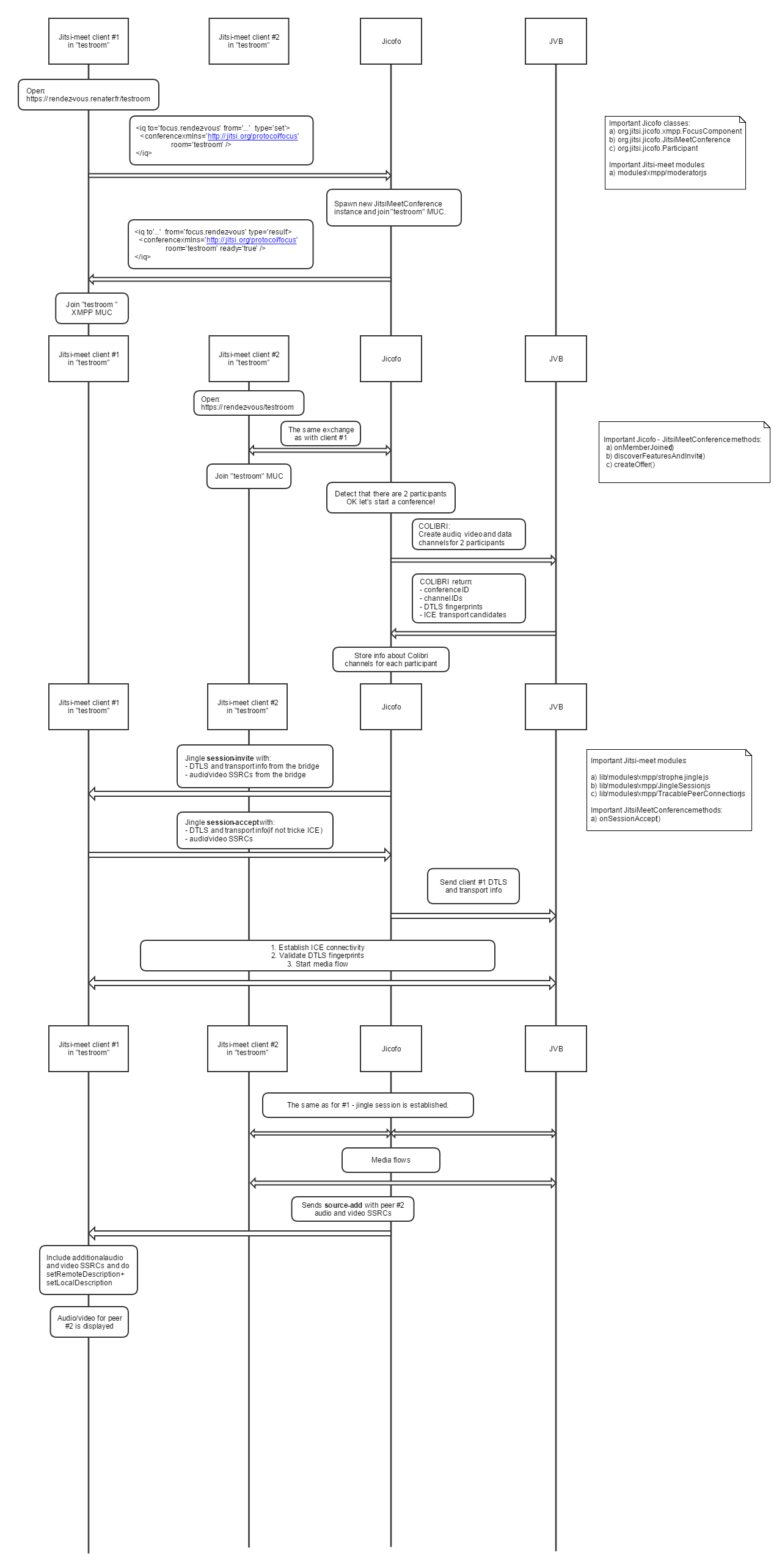
Jitsi architecture
The Jitsi videobridge, also known as jvb, is the component that does the most essential work: it hosts conferences. All users connect to the videobridge; they send their video and audio stream to it, and receive the video and audio streams of the other users from it. Clients talk WebRTC to the videobridge on UDP port 10000 (this does not appear to be configurable).
The videobridge also listens on a TCP port that speaks “Colibri”, a
protocol on top of HTTP/WebSocket. Clients receive extra information
from that connection, such as which users connected or disconnected from
the conference. By default this port is 9090, but here we change it to
9190 in order to not conflict with the prometheus server port. The
videobridge port (that is, 9190) is actually proxied through nginx, so
clients actually connect to nginx at 443, and URL
/colibri-ws/[videobridge-id]/ is proxied to the videobridge.
Although the most common case is for a Jitsi installation to use a single videobridge, you can have many videobridges for better performance if you have many conferences, and each videobridge can host one or more conferences. (A given conference always uses a single videobridge.)
Jicofo, misleadingly meaning “Jitsi conference focus”, is the component that orchestrates conferences. Users connect to jicofo and ask to create or join a conference. Jicofo creates the conference on the less loaded videobridge and directs users to it. All communication between Jicofo and other components goes through prosody (more on that below). Jicofo also listens on TCP port 8888, but this is only an API for diagnostic information or so.
Jitsi-meet is the JavaScript client the user runs on the browser. It is loaded through nginx when the user visits the jitsi web site.
Prosody is a XMPP signaling server that in this case works as a
publish/subscribe queue. Videobridges publish information about
themselves on prosody, and jicofo subscribes to prosody and gets that
information from there. In addition, jitsi meet connects to prosody (via
nginx) and communicates with jicofo through it. Prosody listens on TCP
ports 5222 (XMPP client), 5269 (XMPP server), and 5280 (XMPP BOSH). Most
components, such as Jicofo and videobridges, connect to 5222. Nginx
also proxies /http-bind and /xmpp-websocket to prosody’s 5280.
Jibri is the Jitsi recording component, that records conferences. It works by starting a headless chrome browser that joins the conference as an invisible user.
For additional information on Jitsi, see:
a video on how to load balance jitsi meet, which is useful even if you don’t intend to load-balance.
a related discussion in the forum, notably the RENATER document and the flow chart.
another related discussion in the forum.